
Buyer funds explained
Seller Concessions- How It Works
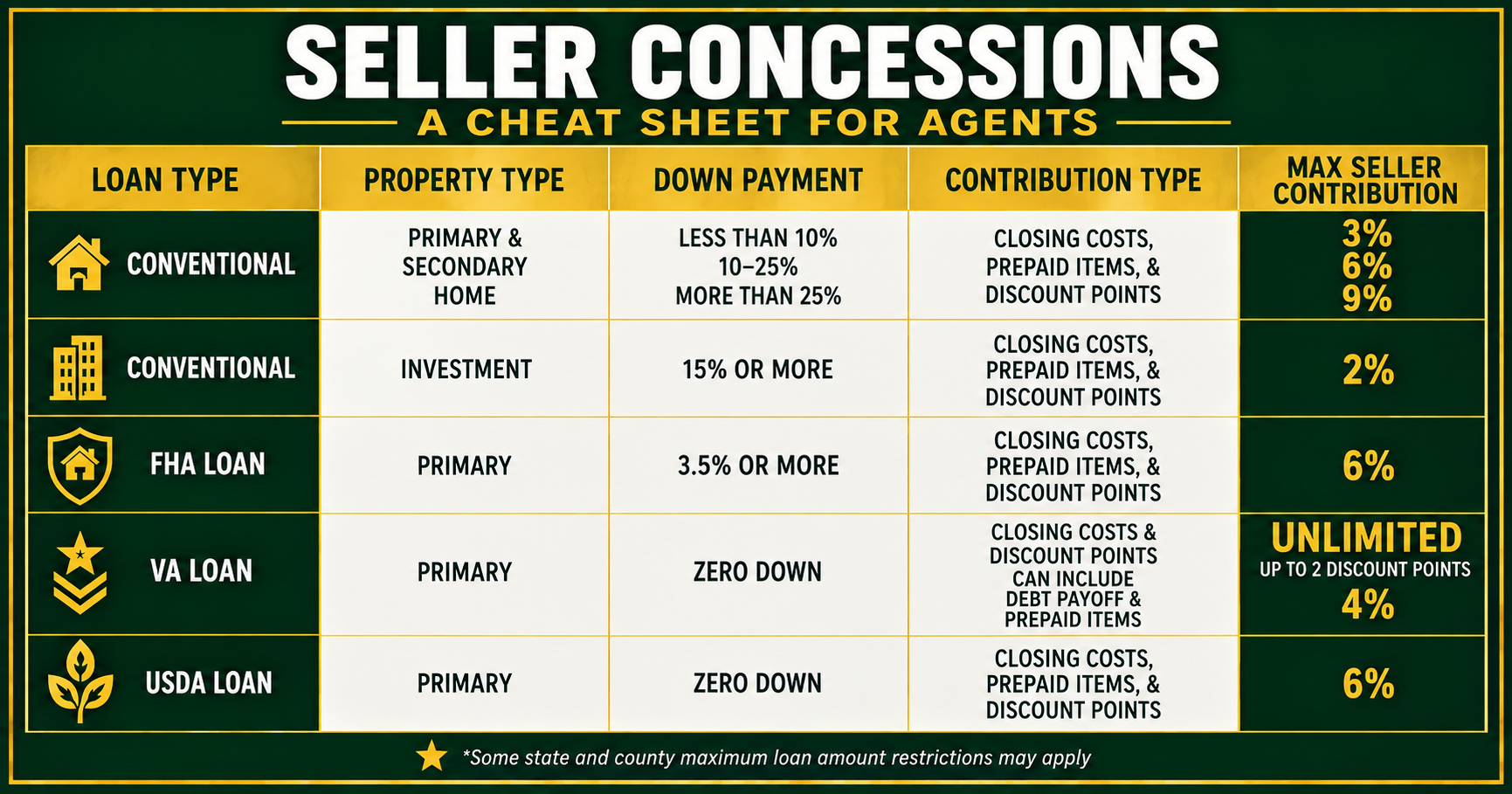
Seller Concessions Explained: How Sellers Can Help Pay a Buyer’s Closing Costs
Seller concessions—also called seller credits—can be a powerful way to reduce the amount of cash a homebuyer needs at closing. Depending on the loan program, they may help pay closing costs, prepaid expenses, or even the cost of obtaining a lower mortgage rate.
What to Know
- Seller concessions can reduce your cash needed at closing.
- Seller credits can pay many closing costs and prepaid expenses.
- Seller credits may be used to buy down your mortgage rate.
- Seller concession limits depend on the loan program & other factors.
- The VA 4% seller concession rule is commonly misunderstood.
- Unused seller credits cannot be received as cash.
- Seller concessions cannot replace your required down payment.
- Increasing the sales price to obtain a seller credit can create appraisal issues.
- A seller credit may be more valuable than a price reduction.
- Seller credits can sometimes fund temporary rate buydowns.
- Seller concessions can benefit both buyers and sellers.
- Seller concessions are negotiable.
- The amount and structure of the seller credit should be planned before writing the offer.
1. Seller Concessions Can Reduce Your Cash Needed at Closing
A seller concession is an agreement in which the seller pays certain eligible costs for the buyer as part of the purchase transaction.
The seller does not normally give the buyer cash. Instead, the agreed-upon credit appears on the closing statement and is applied toward eligible expenses.
For example, if you purchase a $500,000 home and negotiate a $10,000 seller credit, that $10,000 could potentially cover $10,000 of eligible closing costs instead of you paying those costs out of pocket.
This can help buyers preserve more of their savings after purchasing the home.
2. Seller Credits Can Pay Many Closing Costs and Prepaid Expenses
Depending on the loan program and transaction, seller credits may potentially pay for expenses such as lender fees, discount points, appraisal fees, title and escrow charges, recording fees, homeowners insurance, property taxes, initial impound account deposits, certain mortgage insurance or funding fees, and rate buydowns.
Exactly what can be paid depends on the loan program and details of the transaction.
3. Seller Credits May Be Used to Buy Down Your Mortgage Rate
Seller credits aren't necessarily limited to ordinary closing costs.
Depending on the loan program, some or all of the credit may be used to pay discount points to obtain a lower mortgage rate.
If a seller is willing to negotiate $10,000, for example, you might compare a $10,000 reduction in the sales price with a $10,000 seller credit toward closing costs or a rate buydown.
The effect on your cash to close and monthly payment can be very different. Look at the complete loan numbers before deciding.
4. Seller Concession Limits Depend on the Loan Program
Mortgage programs place limits on how much an interested party can contribute toward a buyer's costs.
The maximum can vary based on the loan program, occupancy, loan-to-value ratio, down payment and other transaction details.
Always verify the allowable seller contribution for your particular loan before finalizing the purchase contract.
5. The VA 4% Seller Concession Rule Is Commonly Misunderstood
Many people hear that sellers can pay a maximum of 4% on a VA loan, but that doesn't necessarily mean sellers are limited to paying only 4% of all buyer costs.
Certain normal closing costs and discount points are treated differently from items VA specifically classifies as seller concessions.
As a result, sellers may sometimes pay allowable closing costs in addition to concessions that are subject to the VA 4% limitation.
6. Unused Seller Credits Cannot Be Received as Cash
If your contract provides a $12,000 seller credit but you have only $8,500 of eligible costs, you generally cannot simply receive the remaining $3,500 in cash.
Depending on the transaction, there may be better ways to use the available credit, such as paying discount points, funding a temporary rate buydown, paying eligible prepaid expenses, or funding initial impound account deposits.
This is one reason seller credits should be reviewed well before closing.
7. Seller Concessions Cannot Replace Your Required Down Payment
Seller concessions are generally intended to cover eligible closing costs and prepaid expenses—not your required minimum down payment.
If your loan requires a 3%, 3.5%, 5% or other minimum down payment, you generally cannot use a standard seller credit to satisfy that requirement.
Separate rules determine acceptable sources for your down payment, including your own funds, eligible gifts and qualifying down-payment-assistance programs.
8. Increasing the Sales Price to Obtain a Seller Credit Can Create Appraisal Issues
One strategy is increasing the purchase price in exchange for a seller credit.
For example, instead of purchasing a home for $490,000, the buyer and seller might agree to $500,000 with a $10,000 seller credit.
That can work when the numbers make sense, but the property appraisal still needs to support the higher purchase price.
Increasing the contract price does not automatically increase the home's appraised value. If the appraisal doesn't support the higher price, the transaction may need to be restructured.
9. A Seller Credit May Be More Valuable Than a Price Reduction
Suppose you have a choice between a $10,000 price reduction and a $10,000 seller credit.
A $10,000 reduction in the purchase price may produce only a modest reduction in the monthly mortgage payment.
Using the same $10,000 toward closing costs could allow you to keep substantially more money in savings. Using some of the credit to buy down your mortgage rate could potentially provide a greater monthly-payment benefit.
The best option depends on your available cash, down payment, mortgage pricing, expected time in the home, appraised value and loan program.
Run the numbers before deciding.
10. Seller Credits Can Sometimes Fund Temporary Rate Buydowns
Seller credits may also be used in some transactions to fund a temporary rate buydown, such as a 2-1 buydown.
Money is set aside at closing to subsidize part of your mortgage payment during the introductory period.
Remember that the actual note rate isn't temporarily reduced. When the temporary buydown period ends, you are responsible for the full payment based on the actual mortgage rate.
11. Seller Concessions Can Benefit Both Buyers and Sellers
Buyers may use seller concessions to reduce cash needed at closing, preserve savings, cover closing costs, obtain a lower mortgage rate or reduce their initial payments through a temporary buydown.
Sellers may use concessions to make their property more attractive, compete with other listings, avoid a larger price reduction, overcome a buyer's shortage of closing funds or simply help get the transaction closed.
A properly structured concession can benefit both sides.
12. Seller Concessions Are Negotiable
Sellers generally aren't required to pay a buyer's closing costs simply because the loan program permits seller contributions.
Seller concessions are part of the purchase negotiation.
In a strong seller's market with multiple competing offers, requesting a large credit may make your offer less attractive. When homes are taking longer to sell, seller credits may become a much more effective negotiating tool.
13. Structure the Seller Credit Before Writing the Offer
More seller credit isn't automatically better.
Before negotiating the amount, determine how much of the credit you can actually use, what your loan program allows, and whether the money would be more valuable toward closing costs, discount points, a temporary buydown or a lower purchase price.
You should also consider whether the property is likely to appraise at the negotiated purchase price.
These questions are best answered while you're structuring the offer—not a few days before closing.
The Bottom Line
Seller concessions can substantially reduce a buyer's cash needed at closing and may help pay closing costs, prepaid expenses or the cost of obtaining a lower mortgage rate.
But every loan program has its own rules and limitations.
Instead of asking only, “How much will the seller give me?” a better question is, “What's the smartest way to structure the seller credit for my particular loan?”
Have your loan officer compare the numbers side by side. A change in purchase price, seller credit, interest rate or closing costs can affect both your cash to close and monthly payment.
Seller-contribution guidelines are subject to loan-program requirements, transaction details and lender underwriting. Confirm the allowable contribution for your specific loan before writing the purchase contract.
- #Closing costs
- #monthly payment
- #mortgage rates
- #rate buydown
- #rate shopping
- #First time home buyer
More Buyer funds explained guides
Disclaimer: Informative opinion based on decades of experience, not legal advice. Guidelines change and lenders differ in their interpretation and overlays — verify details with the lender handling your loan.