Buyer funds explained
Closing Costs Tips
Closing Costs Tips: What Homebuyers Need to Know
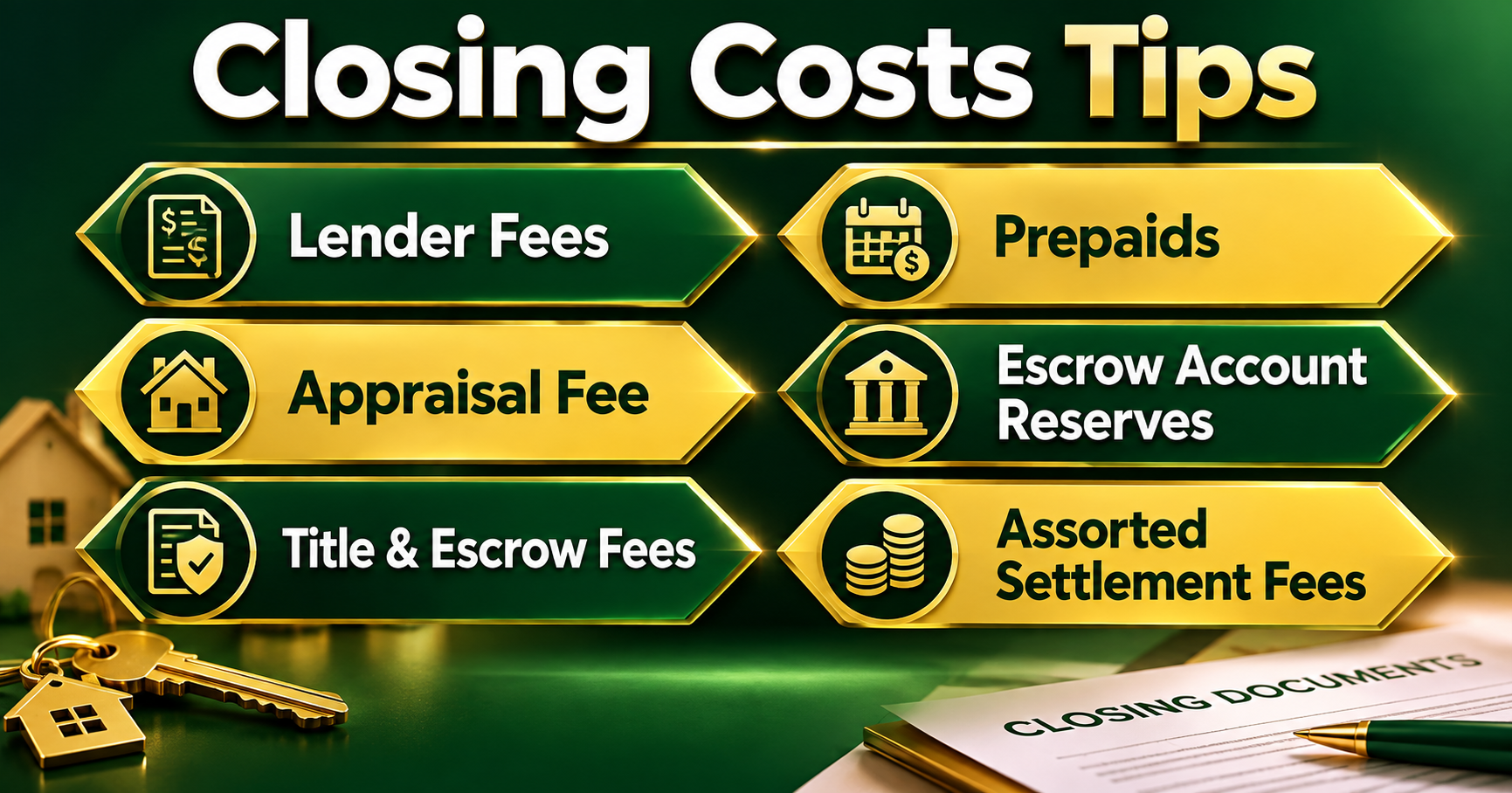
Closing costs are more complicated than your down payment. They can include lender fees, title and escrow charges, insurance, prepaid interest, taxes, impound reserves and other expenses.
The important thing is knowing what you're paying, which costs can vary, and where you may be able to save money.
What to know
- Closing costs are separate from your down payment — Buyers often pay roughly 2% to 5% of the purchase price in closing costs, although every transaction is different.
- Compare lender fees—not just interest rates — Two lenders can offer the same rate while charging very different fees.
- Understand discount points before paying them — Paying points may lower your rate, but calculate how long it will take to recover that upfront cost.
- An appraisal may not always be required — Some conventional loans may qualify for an appraisal waiver or alternative.
- Title and escrow fees can be significant — These costs vary by property, location, service provider and purchase agreement.
- Shop for homeowners insurance early — Insurance costs can affect both your cash to close and your monthly mortgage payment.
- Impound accounts can increase your upfront cash requirement — Initial reserves for property taxes and insurance may add thousands to the amount needed at closing.
- Prepaid interest depends on your closing date — Closing earlier or later in the month can change the amount of prepaid interest collected.
- Property tax prorations aren't lender fees — They are generally adjustments between the buyer and seller based on who owes what portion of the taxes.
- Inspections and HOA expenses can add to your costs — These expenses vary considerably by property and transaction.
- FHA, VA and USDA loans may have program-specific fees — Some can be financed into the loan rather than paid entirely out of pocket.
- Closing costs and cash to close are not the same thing — Your total cash requirement also includes your down payment, prepaid expenses and reserves, minus applicable deposits and credits.
- Shop the loan price—not just the rate — A lower advertised interest rate isn't necessarily the better deal if it comes with substantially higher lender fees or points.
1. Closing Costs Are Separate From Your Down Payment
Your down payment is only one part of the money you may need to purchase a home.
Closing costs typically include expenses associated with obtaining the mortgage and completing the transaction. Depending on the property and loan, they may run approximately 2% to 5% of the purchase price, although the actual amount can vary considerably.
That's why a buyer putting 5% down shouldn't assume that 5% is all the money they'll need to close.
2. Compare Lender Fees—Not Just Interest Rates
One of the biggest mistakes borrowers make is comparing lenders based only on the mortgage rate.
Two lenders might quote exactly the same interest rate but charge dramatically different lender fees and points.
Lender charges can include origination, underwriting, processing, administrative fees, discount points and other charges.
Once you formally apply, your Loan Estimate makes comparing these costs much easier. Pay particular attention to the origination charges in Section A on Page 2.
The better question isn't simply, "What's your rate?"
Ask, "What rate am I getting, and what are all the lender fees and points required to get that rate?"
3. Understand Discount Points Before Paying Them
One mortgage point equals 1% of your loan amount.
For example, one point on a $500,000 mortgage costs $5,000.
Paying points can make sense when they produce a meaningful rate reduction and you expect to keep the mortgage long enough to recover the upfront expense.
Calculate your break-even period before paying points.
If $4,000 in points saves you $100 per month, it takes approximately 40 months to recover that $4,000.
If you expect to refinance or sell before reaching the break-even point, paying those points may not make financial sense.
4. An Appraisal May Not Always Be Required
An appraisal may be required to establish the property's market value and confirm that the home meets applicable lending requirements.
The cost can vary based on the property's location, type, complexity and loan program.
Rural properties, acreage and unusual homes may cost more to appraise because they can require additional research or travel.
However, not every conventional mortgage requires a traditional appraisal. Automated underwriting systems may sometimes provide an appraisal waiver or other alternative for eligible transactions.
5. Title and Escrow Fees Can Be Significant
Title and escrow charges can represent a substantial portion of your closing costs.
These may include escrow or settlement services, title searches, title insurance, recording, document preparation, notary services and other transaction expenses.
Costs can vary based on the property's location, purchase price, loan amount and service providers.
There can also be regional differences in California regarding how title and escrow services are handled and which party customarily pays particular charges.
6. Shop for Homeowners Insurance Early
You'll generally need homeowners insurance before your mortgage can close, and you're free to choose your insurance company.
Insurance costs can vary dramatically depending on the home's location, size, construction, replacement cost, claims history and wildfire exposure.
This is especially important in California, where homeowners insurance can sometimes be expensive or difficult to obtain.
Don't wait until the last minute. A high insurance premium can increase both your cash needed at closing and your monthly housing expense—and may even affect loan qualification.
7. Impound Accounts Can Increase Your Upfront Cash Requirement
An impound account, also called an escrow account, allows your mortgage servicer to collect money each month for property taxes and homeowners insurance.
When the account is established, an initial reserve is generally collected at closing.
Depending on the closing date, tax due dates and insurance premium, these reserves can add thousands of dollars to your cash needed at closing.
However, this isn't a lender fee. The money is placed into your account to pay future property tax and insurance bills.
8. Prepaid Interest Depends on Your Closing Date
Mortgage interest is generally paid in arrears, meaning each regular payment covers interest from the preceding month.
At closing, you'll typically pay interest from your closing date through the end of that month.
If you close near the end of the month, there may only be a few days of prepaid interest. Close near the beginning of the month, and you'll generally have more.
That's one reason your estimated closing costs can change when your closing date changes.
9. Property Tax Prorations Aren't Lender Fees
Property taxes may create credits or charges between the buyer and seller.
Depending on when the transaction closes and which tax installments have already been paid, the escrow or settlement company calculates adjustments so each party pays the appropriate share.
These amounts can make your closing statement look more complicated, but they're generally accounting adjustments between buyer and seller—not fees being charged by your mortgage lender.
10. Inspections and HOA Expenses Can Add to Your Costs
Depending on the property, you may pay for home, pest, roof, well, septic, foundation or other specialized inspections.
Some of these expenses may be paid before closing.
Properties with homeowners associations may also have document, certification, transfer and prorated HOA fees.
Condominiums can have additional HOA-related requirements, so identifying these costs early is important.
11. FHA, VA and USDA Loans May Have Program-Specific Fees
Government-backed mortgages can have additional program-specific charges.
FHA loans generally have an upfront mortgage insurance premium, which can usually be financed, along with ongoing mortgage insurance.
USDA Guaranteed loans generally have an upfront guarantee fee that can usually be financed, plus an annual fee paid monthly.
VA loans may have a funding fee based on factors such as eligibility, down payment and previous use of the VA loan benefit. Some eligible veterans are exempt from the funding fee.
Because these program requirements can change, verify the current fees for your specific loan.
12. Closing Costs and Cash to Close Are Not the Same Thing
This is an important distinction.
Closing costs are the expenses associated with obtaining your mortgage and completing the transaction.
Cash to close includes more than closing costs.
Your approximate cash requirement can include:
Down payment + closing costs + prepaid expenses + initial impound reserves − deposits − seller credits − lender credits = approximate cash needed at closing.
This is why knowing your down payment alone doesn't tell you how much money you'll actually need to complete the purchase.
13. Shop the Loan Price—Not Just the Rate
This may be the most important closing-cost tip.
A lender advertising a lower interest rate isn't necessarily offering you the less expensive mortgage.
For example, one lender might offer a slightly lower rate but require thousands of dollars more in lender fees and points.
To determine which mortgage provides the better value, compare the interest rate, lender fees, points, monthly payment, upfront cost and break-even period together.
Don't just ask:
"Who has the lowest rate?"
Ask:
"What is the total loan price for that rate?"
A slightly lower rate accompanied by thousands of dollars in additional fees may not be the better deal.
Bottom Line
Closing costs aren't one single fee. They're a collection of lender charges, title and escrow expenses, insurance costs, prepaid items, tax adjustments, impound reserves and other expenses involved in completing a home purchase and mortgage.
Some costs are relatively fixed, while others—particularly lender fees and points—can vary substantially from one lender to another.
Review your Loan Estimate carefully and compare the complete loan price.
The goal isn't simply to find the lowest advertised mortgage rate. It's to find the best combination of rate, fees, monthly payment and total cost for your particular situation.
- #Closing costs
- #rate shopping
- #mortgage rates
- #rate buydown
More Buyer funds explained guides
Disclaimer: Informative opinion based on decades of experience, not legal advice. Guidelines change and lenders differ in their interpretation and overlays — verify details with the lender handling your loan.