
Refinancing Tips
When Does a Refi to a Higher Rate Make Sense?
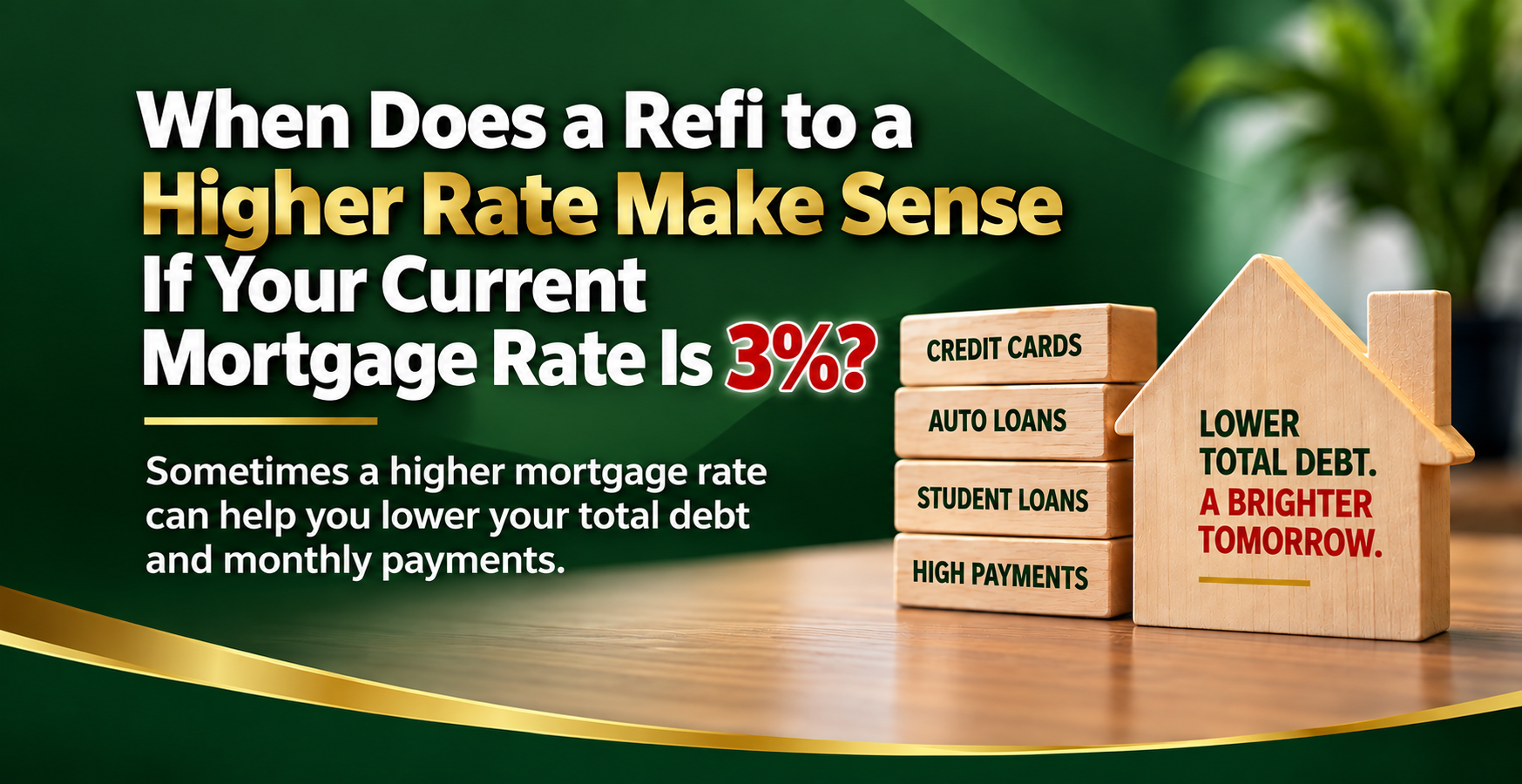
When Does a Refi to a Higher Rate Make Sense If Your Current Mortgage Rate Is 3%?
If you have a 3% mortgage rate, refinancing into a 6% mortgage probably sounds crazy.
Why would anyone voluntarily give up a 3% mortgage?
In most situations, you wouldn't.
But there is one situation where refinancing to a higher mortgage rate can potentially make financial sense: you have substantial home equity AND you're buried in high-interest consumer debt.
The mistake is looking only at your mortgage rate.
You need to look at the total cost of ALL your debt and your total monthly payments.
What to know
- A 3% first mortgage is extremely valuable. Don't give it up without carefully running the numbers.
- Credit card debt at 25%+ can overwhelm the savings from a low mortgage rate. The total debt picture matters more than one interest rate.
- A cash-out refinance could dramatically reduce monthly payments by consolidating expensive credit cards, auto loans, student loans, and other debt into one mortgage payment.
- A HELOC may be an even better alternative because it can allow you to keep your 3% first mortgage while using your equity to consolidate higher-rate debt.
- Lower monthly payments don't automatically mean lower total cost. Stretching short-term debt over many years can increase the total interest paid.
- The goal isn't simply to get the lowest mortgage rate. The goal is to determine which debt structure makes the most financial sense for your situation.
The 3% Mortgage Trap
A homeowner sees a 3% mortgage and understandably thinks:
"I'm never touching that loan." And you may be right.
But what if you're simultaneously paying:
- 25%+ on credit cards
- 8% or more on an auto loan
- 10% or more on student loans
- Thousands of dollars every month toward consumer debt
Suddenly, that 3% mortgage isn't the entire financial picture.
Your mortgage might be cheap, while the rest of your debt is extremely expensive.
Here's an Example
Suppose you have approximately a $570,000 home with the following debts:
Current first mortgage
- $300,000 is the paid down balance
- 3% interest rate
- Approximately $1,400 monthly principal and interest (could be far more)
Credit cards
- $50,000 balance
- 25% interest rate
- Approximately $1,300 in monthly minimum payments
- And paying only the minimum can keep you in credit card debt for a very long time.
Auto loan
- $50,000 balance
- Approximately $900 monthly payment
Student loans
- $50,000 balance
- Approximately $1,000 monthly payment
Total monthly debt payments: approximately $4,600
You're sitting on a great 3% mortgage.
But you're still sending roughly $4,600 every month toward these debts.
That's the number we need to pay attention to.
Option #1: Cash-Out Refinance
Now suppose you replaced these debts with approximately a:
$450,000 cash-out first mortgage
At an illustrative 6% interest rate on a 30-year fixed loan, principal and interest would be approximately:
$2,698 per month
Compare that with approximately $4,600 in existing monthly debt payments.
Potential monthly cash-flow improvement: about $1,900
That's about $23k per year in improved monthly cash flow.
Yes, you gave up your 3% mortgage.
But you also eliminated approximately $150,000 of much more expensive consumer debt.
That's why simply saying, "Never refinance a 3% mortgage," can be too simplistic.
You need to run the numbers.
Option #2: Keep the 3% Mortgage and Use a HELOC
This may be the more interesting option.
Instead of refinancing the entire first mortgage, you could potentially leave that 3% mortgage completely alone and use a home equity line of credit to consolidate the high-interest consumer debt.
For example:
Existing first mortgage
$300,000 at 3%
Approximately $1400 P&I
New HELOC
$150,000 at an illustrative 7% rate
Interest-only payment approximately $875 per month
Combined payments:
Approximately $2,275 per month
Compare that with the approximately $4600 you're currently paying.
Potential monthly cash-flow improvement: approximately $2,325!
And most importantly:
You kept your 3% first mortgage.
That can be a powerful strategy when the numbers work.
But There Is a BIG Catch
Reducing your monthly payment isn't the same thing as reducing your total cost.
If you take credit card, auto, or student loan debt that might otherwise be paid off relatively quickly and stretch it over 20 or 30 years, you could pay considerably more interest over time.
A HELOC can also carry a variable interest rate, meaning the payment and rate can increase, however so can the credit card rates.
And when unsecured consumer debt is consolidated into a mortgage or HELOC, you're potentially converting it into debt secured by your home.
That makes disciplined repayment extremely important.
Don't Consolidate Debt Just to Run the Cards Back Up
This is one of the biggest dangers of debt consolidation.
Someone pays off $50,000 in credit cards using home equity and suddenly those cards have zero balances again.
Then the spending starts over.
A few years later, they have:
- A larger mortgage or HELOC
- Another $50,000 in credit card debt
- And an even bigger financial problem
Debt consolidation works best when it's combined with a plan to keep the consumer debt from coming back.
Compare Both Strategies Before Making a Decision
If you have a low-rate first mortgage and substantial high-interest debt, don't automatically refinance your first mortgage.
Run both scenarios:
Cash-out refinance: Replace the existing mortgage and consumer debt with one new first mortgage.
HELOC or home equity loan: Keep the low-rate first mortgage and use a second loan to consolidate the higher-rate debt.
Then compare:
- Monthly payment
- Interest rates
- Closing costs and lender fees
- Fixed versus variable rates
- Total interest over your expected repayment period
- How quickly you plan to repay the consolidated debt
- Available home equity
- Your overall financial goals
The lowest monthly payment isn't necessarily the best deal.
The Bottom Line
Would I automatically refinance a 3% mortgage into a 6% mortgage? No.
But would I at least run the numbers if that homeowner had $150,000 of credit cards, auto loans, student loans, and other expensive debt?
Absolutely.
Your mortgage rate doesn't exist in a vacuum.
If you're paying 25% on credit cards, 10% on student loans, and 8% on an auto loan, your total debt picture could be far more important than protecting one low mortgage rate at all costs.
And before replacing that 3% first mortgage, investigate whether a HELOC or home equity loan could accomplish the same objective while preserving your low-rate first mortgage.
Sometimes the smartest loan isn't the one with the lowest individual interest rate.
It's the loan structure that makes the most sense when you look at ALL the numbers.
Want Me to Run the Numbers?
If you have substantial home equity and high-interest debt, I'll compare the options for you.
Cash-out refinance vs. keeping your low-rate first mortgage and using a HELOC.
I'll show you the numbers side by side so you can see the potential monthly savings, costs, and tradeoffs before making a decision.
Examples are for illustration only. Actual rates, payments, qualification requirements, closing costs, HELOC terms, and available equity will vary. Principal-and-interest examples do not include taxes, insurance, HOA dues, or other housing expenses.
- #refinance
More Refinancing Tips guides
Disclaimer: Informative opinion based on decades of experience, not legal advice. Guidelines change and lenders differ in their interpretation and overlays — verify details with the lender handling your loan.