
Rate Tips
APR vs the loan Rate
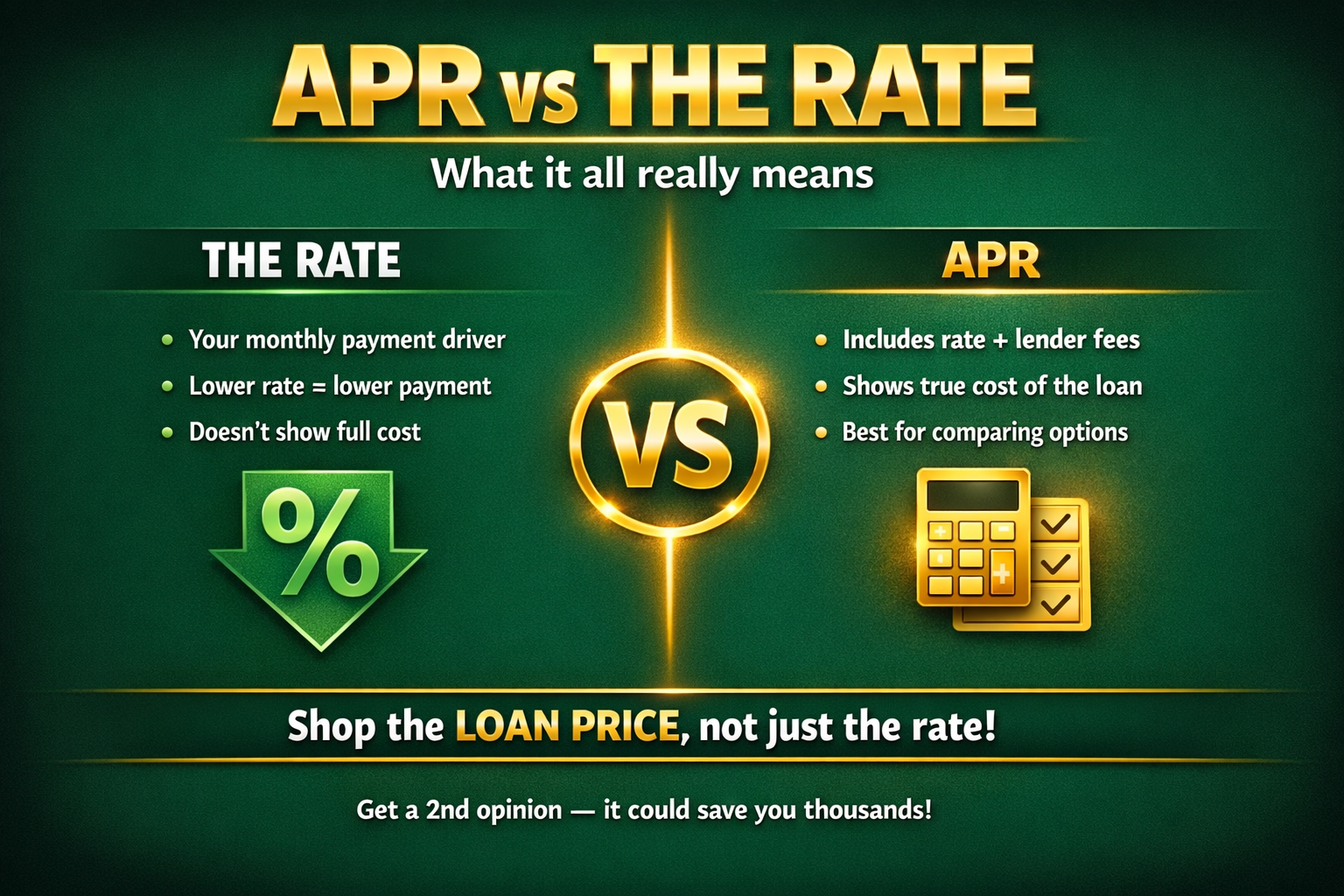
APR vs. the Loan Rate — What’s the Difference?
What to know
- The lowest mortgage rate isn’t always the lowest-cost loan.
- Paying points and lender fees for a lower rate can take years to pay off.
- APR combines the interest rate with certain loan costs to help show the overall cost of financing.
- Your mortgage payment is based on the interest rate—not the APR.
- The lowest APR doesn’t automatically mean the best deal.
- APR has limitations, so compare similar loans and look at the actual costs.
- How long you expect to keep the loan should help determine whether paying extra for a lower rate makes sense.
1. The lowest mortgage rate isn’t always the lowest-cost loan.
A lower interest rate often comes with higher upfront lender fees or discount points. That means borrowers should look beyond the advertised rate and consider what they are actually paying to obtain that rate.
For example, suppose one rate costs $5,000 in additional fees while a slightly higher rate has no additional lender cost and increases the payment by $100 per month. It would take approximately 50 months just to recover that $5,000 through the lower monthly payment.
If you sell the home or refinance before reaching the break-even point, paying the extra money upfront may not have saved you anything.
2. Paying points and lender fees for a lower rate can take years to pay off.
Extremely low advertised mortgage rates can look attractive, but borrowers need to determine how much the lender is charging to obtain that rate.
The important question is:
How long will it take for the monthly savings from the lower rate to recover the additional upfront cost?
Sometimes the break-even period can be five years, ten years or even longer. If you don't expect to keep that particular mortgage long enough to reach the break-even point, paying substantial additional fees for the lower rate may not make financial sense.
3. APR combines the interest rate with certain loan costs to help show the overall cost of financing.
APR stands for Annual Percentage Rate. It attempts to provide a broader measurement of borrowing costs than the mortgage interest rate alone.
Depending on the loan, costs affecting APR can include discount points, origination charges, prepaid interest, mortgage insurance and certain other closing costs.
Because APR incorporates certain costs in addition to interest, it can be useful when comparing similar mortgage offers.
However, don't rely exclusively on APR. Look carefully at the actual interest rate, lender fees, points, closing costs and loan terms.
4. Your mortgage payment is based on the interest rate—not the APR.
The mortgage interest rate is used to calculate the principal-and-interest portion of your monthly loan payment.
APR is different. It is primarily a disclosure designed to give borrowers another way to evaluate the cost of financing.
For example, a loan might have a 6.25% interest rate but an APR that is higher because certain loan costs are incorporated into the APR calculation.
Your payment is calculated using the 6.25% note rate—not the higher APR.
5. The lowest APR doesn’t automatically mean the best deal.
A lower APR can sometimes result from paying more money upfront to obtain a lower interest rate.
That may be worthwhile if you plan to keep the mortgage long enough to recover those additional costs. But if you sell or refinance before reaching the break-even point, the additional upfront expense may outweigh the monthly savings.
This is why you shouldn't automatically choose a mortgage simply because it has the lowest APR.
Compare the actual dollars involved.
6. APR has limitations, so compare similar loans and look at the actual costs.
APR is useful, but it isn't a perfect comparison tool.
APR calculations can vary depending on which costs apply to the loan, the amount of prepaid interest and when during the month the loan closes.
Adjustable-rate mortgages can make APR comparisons even more complicated because the APR calculation must account for potential rate adjustments after the initial fixed-rate period.
APR is most useful when comparing similar loans with the same approximate loan amount and term.
For example, comparing the APR of a 30-year fixed-rate mortgage directly with the APR of a 5/1 adjustable-rate mortgage may not provide a meaningful apples-to-apples comparison.
7. How long you expect to keep the loan should help determine whether paying extra for a lower rate makes sense.
One of the biggest weaknesses of APR is that its calculation generally assumes you'll keep the mortgage for its full term.
Many homeowners don't.
They may sell, refinance or pay off the mortgage years before the original loan term ends.
That's why the break-even point is so important.
Instead of asking only:
"Who has the lowest rate?"
Ask:
"What does that rate cost, how much does it save me each month, and how long will it take me to recover the additional upfront cost?"
The best way to compare mortgage offers is to look at the complete loan price—the interest rate, lender fees, points, closing costs and expected monthly payment—and then consider how long you realistically expect to keep the loan.
But watch out!!!

Many online lenders and even big well known lenders under-disclose and misrepresent these APR impact fees at the beginning--while you are rate shopping-- resulting in an initial lower "false" APR tricking you into thinking they offer the best deal. Since the APR can change prior to closing, they bait the hook with these lies and then before closing they switch and increase these impact fees and even lender fees resulting in a higher final APR than the one you could have received from an honest lender.
Shop the loan price, not just the rate.
More Rate Tips guides
Disclaimer: Informative opinion based on decades of experience, not legal advice. Guidelines change and lenders differ in their interpretation and overlays — verify details with the lender handling your loan.