
Monthly Payment Tips
Seller Funded Buydowns: Everything You Need to Know

Seller-Funded Temporary Rate Buydowns: What Homebuyers Need to Know
A seller-funded temporary rate buydown can lower your mortgage payment during the first few years of homeownership. It can be a valuable tool, but the lower payment is temporary, so it’s important to understand the full cost and long-term payment before deciding whether a buydown makes sense.
What to know
- A temporary buydown lowers your payment—not your actual mortgage note rate.
- Common options include 3-2-1, 2-1 and 1-0 buydowns.
- The seller typically funds the payment reduction through a closing-cost credit.
- You generally need to qualify using the full mortgage payment.
- Compare a buydown with other uses of the seller credit.
- Don’t assume you’ll be able to refinance before the buydown expires.
- Find out what happens to unused buydown funds if you sell or refinance early.
- Seller credits and buydowns are subject to loan-program limits.
- Temporary and permanent rate buydowns work very differently.
- Make sure you can comfortably afford the full payment when the buydown ends.
- Link to my buydown calculator here.
1. A Temporary Buydown Lowers Your Payment—not Your Note Rate
A temporary buydown uses money contributed at closing to subsidize part of your mortgage payment for a limited period.
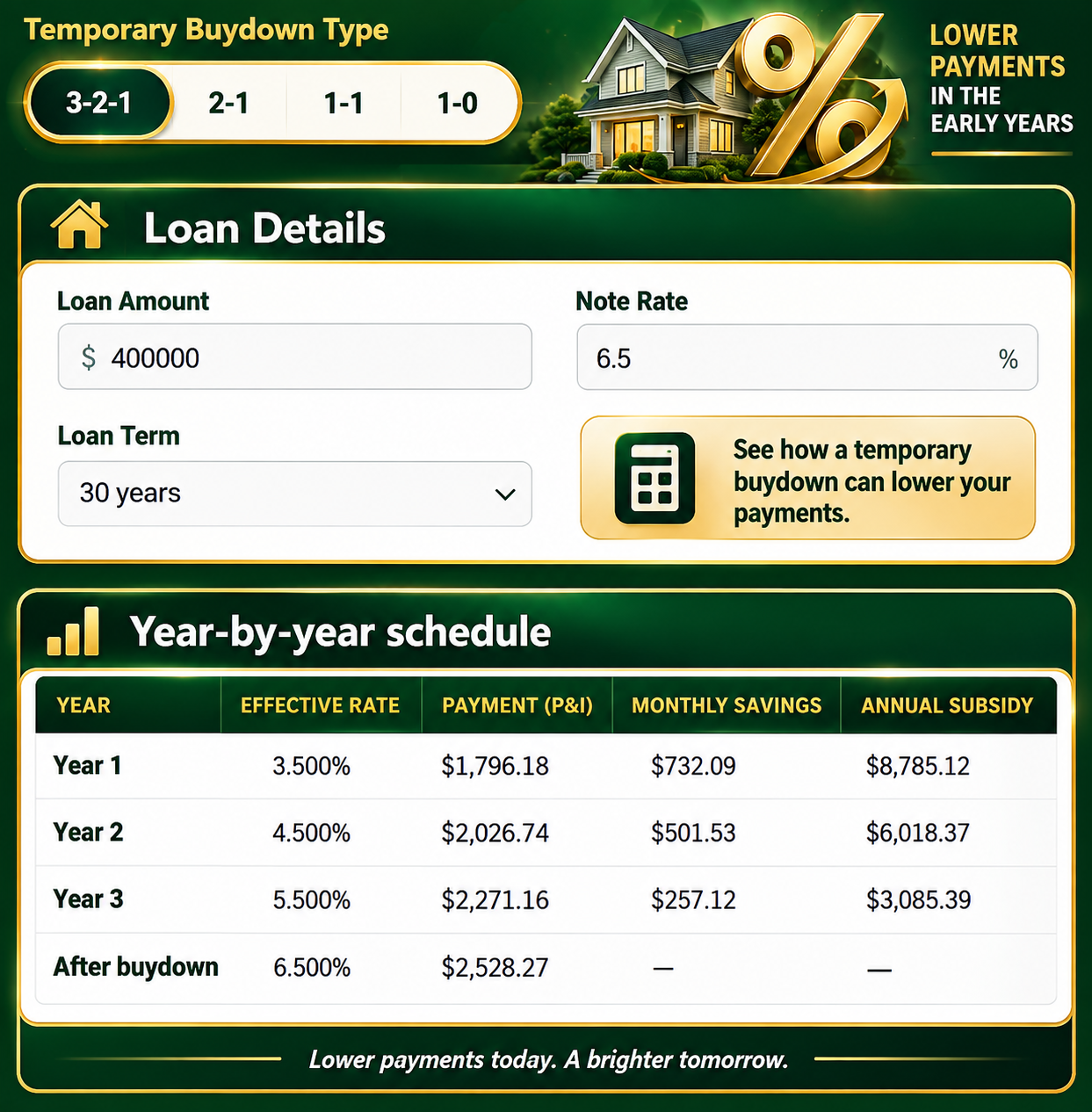
For example, with a 6.50% fixed note rate and a 2-1 buydown, your payment could initially be calculated as though the rate were 4.50% in year one and 5.50% in year two. Beginning in year three, you make the full payment based on the 6.50% note rate.
The actual mortgage rate remains 6.50% throughout the loan.
2. Common Buydown Options Include 3-2-1, 2-1 and 1-0
A 3-2-1 buydown reduces the payment for three years, a 2-1 buydown for two years and a 1-0 buydown for one year.
Using a 6.50% note rate as an example, a 3-2-1 buydown could provide payments based on 3.50% the first year, 4.50% the second year and 5.50% the third year before reaching the full 6.50% payment.
The larger and longer the payment reduction, the more money is generally required to fund it.
3. The Seller Typically Funds the Buydown
With a seller-funded buydown, the seller provides a credit at closing. Part or all of that credit is placed into a buydown account and used to subsidize the buyer’s initial payments.
The cost depends on the difference between the temporary reduced payments and the payments required at the actual note rate.
4. You Generally Qualify Using the Full Mortgage Payment
One of the most important things to understand is that the lower introductory payment generally does not mean you can qualify for a larger mortgage.
With many standard loan programs, borrowers must qualify using the actual note rate and corresponding qualifying payment.
That helps ensure you can afford the mortgage after the temporary subsidy ends.
5. Compare the Buydown With Other Uses of the Seller Credit
Suppose a seller is willing to provide $15,000 in concessions. That money might be used for a temporary buydown, allowable closing costs, a permanent rate buydown, a price reduction or a combination of these strategies.
The best choice depends on your loan amount, available cash, interest rate, expected time in the home and overall financial goals.
Don’t automatically assume the temporary buydown provides the greatest value. Compare the actual numbers first.
6. Don’t Count on Refinancing Later
You may hear that you can enjoy the lower payment now and simply refinance when mortgage rates fall.
That might happen—but there is no guarantee.
Mortgage rates could decline, remain near current levels or increase. You should therefore be comfortable making the full payment at the note rate even if refinancing never becomes attractive.
Think of refinancing as a potential future opportunity, not something required to make your mortgage affordable.
7. Ask What Happens to Unused Buydown Funds
If you sell the home or refinance before the temporary buydown period ends, money may still remain in the buydown account.
How those funds are handled depends on the buydown agreement and applicable loan requirements. Unused funds may be applied toward the mortgage payoff or handled in another permitted manner.
Ask your loan officer to explain this before you sign the buydown agreement.
8. Seller Credits and Buydowns Have Limits
Sellers cannot contribute unlimited amounts toward a buyer’s mortgage transaction.
Allowable seller contributions can depend on the loan program, occupancy, loan-to-value ratio, down payment and type of contribution.
Conventional, FHA, VA and USDA financing each have their own requirements. Ideally, the proposed buydown should be calculated before the purchase contract and seller credit are finalized.
9. Temporary and Permanent Buydowns Are Different
A temporary buydown reduces your payment for a limited period without changing the underlying note rate.
A permanent buydown typically uses discount points to obtain a lower mortgage rate, which can reduce the principal-and-interest payment for as long as you keep that mortgage.
If you expect to keep the loan for many years, a permanent rate reduction may provide more long-term value. If you expect to sell or refinance sooner, the calculation may be different.
The best way to decide is to compare the actual cost and potential savings of each option.
10. Make Sure You Can Afford the Full Payment
Temporary buydowns can be especially useful for buyers who want lower payments during the first few years, expect their income to increase, want additional short-term cash-flow flexibility and have a seller willing to contribute toward closing costs.
But a temporary buydown should not be used to make an otherwise unaffordable mortgage appear affordable.
Before closing, make sure you know exactly what your payment will be after the buydown expires—and that you are comfortable making it.
The Bottom Line
Seller-funded temporary rate buydowns can be a valuable negotiating and financing tool, particularly when a seller is willing to provide a substantial credit.
But the lowest first-year payment doesn’t necessarily mean the best deal.
Compare the temporary buydown with seller-paid closing costs, a permanent rate buydown and a price reduction. The goal is to use the available seller credit in the way that provides the greatest overall financial benefit.
Mortgage guidelines and lender requirements can change, and seller-contribution and buydown rules vary by loan program and lender. Verify the requirements for your specific transaction with the lender handling your loan.
- #rate buydown
- #payment stategy
More Monthly Payment Tips guides
Disclaimer: Informative opinion based on decades of experience, not legal advice. Guidelines change and lenders differ in their interpretation and overlays — verify details with the lender handling your loan.